Self custody crypto wallet essentials for Web3 gamers
- A self custody crypto wallet changes the balance sheet of a Web3 game account.
- The asset is no longer just a database entry controlled by a studio.
- It is a token controlled by a private key.
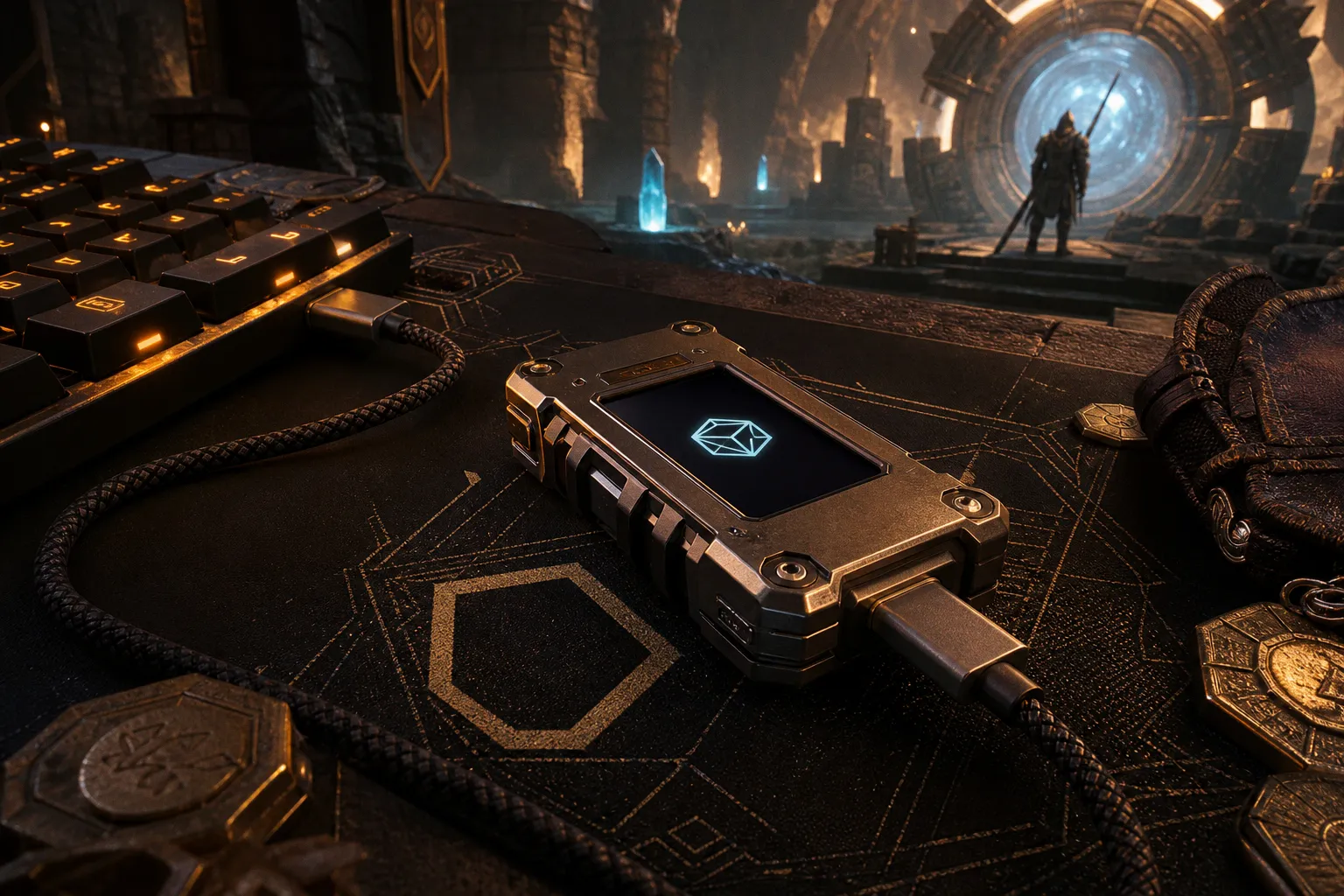
The trade-off is clean. Custody risk falls. Key-management risk rises. No marketing layer removes that equation. A non-custodial gaming wallet can protect assets from platform seizure, but it can also turn one lost seed phrase into a permanent write-off.
The mechanics of true ownership: why self-custody matters in GameFi
Self-custody means the user holds the private keys or seed phrase. No exchange. No game publisher. No marketplace custodian. Control sits with the wallet signer.
For GameFi, that matters because assets are financial instruments wearing game skins. Their value depends on liquidity, scarcity, emissions, utility, and transferability. If a studio can freeze the asset, ownership is conditional. If a marketplace wallet controls withdrawal, exit liquidity is mediated. If a centralized account can be closed, the asset is not fully bearer.
A self custody crypto wallet changes three flows:
- Transfer flow: The user can send assets to another wallet, marketplace, lending contract, bridge, or cold-storage address without platform approval.
- Trading flow: The user can list, delist, or arbitrage across markets when spreads appear, assuming the chain and marketplace support the asset.
- Risk flow: The user absorbs signing risk, malware risk, seed phrase loss, and operational mistakes.
The point is not ideology. It is settlement control.
In a conventional game, a rare item has value inside the publisher’s database. In a Web3 game, the same item may settle as an NFT or fungible token on-chain. The wallet becomes the clearing account. The game client becomes one interface among several.
That distinction matters during stress. When a token collapses, the useful question is not whether players “own” the asset in a slogan sense. The useful question is whether they can move it before floor resistance breaks, bridge liquidity thins, or a marketplace halts listings.
Self-custody does not make a game economy solvent. It only gives the holder direct control over the exit path.
There is also a governance angle. If assets sit in custodial accounts, voting power and claim rights can be pooled or restricted. If they sit in self-custody wallets, the distribution of control is clearer on-chain. Analysts can track wallet concentration, whale behavior, staking flows, and unlock pressure with less custodial opacity.
That does not make the data perfect. Wallet clustering is noisy. Sybil wallets distort user counts. But on-chain asset control is still easier to audit than internal game-account balances.
Hot wallets, cold storage, and the real security spectrum
The wallet market usually gets divided into “hot” and “cold.” That split is useful, but incomplete.
A hot wallet is connected to an internet-enabled device. It is convenient for gameplay, minting, marketplace approvals, staking, and microtransactions. It is also exposed to browser exploits, fake signatures, malicious extensions, compromised devices, and phishing.
A hardware wallet keeps private keys offline. It is better for high-value assets. It is worse for fast interaction. No one wants to confirm every low-value crafting transaction on a device while gas and market spreads are moving.
For gaming portfolios, the practical structure is usually tiered.
| Wallet role | Best use | Main risk | Typical asset type |
|---|---|---|---|
| Gameplay hot wallet | Daily play, low-value claims, session activity | Malware, phishing, bad approvals | Consumables, low-floor NFTs, small token balances |
| Trading wallet | Marketplace listings, arbitrage, bridge activity | Contract approval exposure, slippage, bridge risk | Liquid NFTs, reward tokens, marketplace inventory |
| Vault wallet | Long-term storage | Seed loss, poor recovery process | Rare NFTs, land, governance tokens, high-value skins |
| Hardware wallet | Offline key protection | Lower usability, signing friction | Treasury-grade game assets, illiquid collectibles |
The mistake is treating wallet setup as a one-time choice. It is an allocation model.
Assets with different liquidity profiles should not sit under the same signing pattern. A floor item used for daily play and a land NFT with thin supply should not share the same hot wallet exposure. Their drawdown profiles differ. Their recovery options differ. Their attack surface differs.
Self-custody wallet security starts with segmentation:
1. Separate gameplay from storage. The wallet used for frequent game interactions should not hold the full inventory. It should hold working capital.
2. Use limited balances. A gameplay wallet should carry enough gas and tokens to function, not enough to create a meaningful loss event.
3. Revoke stale approvals. NFT and token approvals can become latent liabilities. If a contract is compromised or a phishing signature grants transfer rights, the wallet may be drained without a conventional “login breach.”
4. Move high-value assets to cold storage. Hardware wallets are slower. That is the point. Friction is a security cost, but also a loss-control mechanism.
5. Treat bridges as trading venues, not plumbing. Cross-chain movement adds smart-contract and liquidity risk. It is not a neutral transfer rail.
The user interface hides too much. “Connect wallet” looks harmless. It is not always harmless. The relevant object is the signature request. A signature can approve spending rights, list an asset, delegate control, or authorize a transaction routed through a contract the user does not understand.
Game clients and marketplaces have improved readable transaction prompts, but the asymmetry remains. The attacker only needs one blind signature. The holder needs operational discipline every time.
Account abstraction turns wallets into game infrastructure
ERC-4337 was deployed on Ethereum mainnet in March 2023. Its core value for games is not branding. It allows smart contract wallets to handle account logic that externally owned accounts cannot handle cleanly.
The practical features are direct:
- Gasless-feeling transactions: A relayer, paymaster, or developer-side system can pay gas on the backend. The user may not need to hold native gas tokens for every interaction.
- Session keys: A player can approve limited actions for a defined period or scope. That reduces repeated signing during gameplay.
- Social recovery: Wallet recovery can use trusted contacts, devices, or recovery mechanisms instead of relying only on one seed phrase.
- Policy controls: Smart wallets can restrict certain interactions, set spending limits, or require extra verification for high-value transfers.
The word “gasless” needs control. It does not mean zero cost. It means the cost is abstracted. Someone still pays. Usually the developer, a relayer, a paymaster, or the user indirectly through fees, spreads, token sinks, or monetization.
For Web3 games, ERC-4337 is a structural fix for the worst part of wallet UX: every minor action competing with financial signing. Games need high-frequency interactions. Blockchains price state changes. The mismatch is obvious.
A good web3 game wallet setup should not require a player to stop every 20 seconds to approve a minor action with full account authority. Session keys narrow the blast radius. A player can authorize routine actions while reserving higher-friction confirmation for transfers, listings, bridging, or large swaps.
This matters for both retention and exploit containment. If every action uses the same master signing authority, the account is brittle. If routine gameplay runs through limited permissions, the system can absorb more front-end noise without exposing the vault.
Account abstraction is not a yield engine. It is loss control and transaction routing dressed as user experience.
For game studios, the accounting is also cleaner. If developers subsidize gas, it becomes a cost center. That cost must be modeled against player lifetime value, transaction volume, token emissions, and sink design. Subsidized transactions can increase activity metrics while draining treasury balances. Bad dashboards celebrate the activity. Good dashboards track the subsidy burn.
This is where gaming wallets converge with broader fintech UX. Retail platforms have long understood that custody, routing, and interface design shape behavior; the same logic appears in trading products, including the platform strategy discussed in Robinhood’s long-term story beyond crypto trading. GameFi cannot avoid that layer. Wallet design is market structure.
Layer 2 networks reduce friction, but they do not erase cost
Ethereum mainnet is rarely the right venue for high-frequency game actions. The cost structure is wrong. EIP-1559, implemented in August 2021, improved gas fee predictability through a base fee mechanism, but predictability is not affordability.
GameFi therefore leans on Layer 2 networks and sidechain-style scaling environments. Arbitrum, Optimism, and Polygon zkEVM are common references in the infrastructure stack. The core claim is simple: transaction costs can be 10x to 100x lower than Ethereum L1, depending on network load and implementation.
That range is not a guarantee. Specific gas benchmarks vary by chain, congestion, calldata costs, and application design. Any deck showing a single universal fee number is reducing a variable expense into a sales metric.
For wallet design, L2s change the operating model:
- More actions can settle on-chain. Crafting, claiming, swapping, upgrading, and marketplace interactions become economically viable at smaller ticket sizes.
- Game loops can use real asset movement. If fees are too high, developers fake ownership through off-chain balances and periodic settlement. Lower fees reduce that compromise.
- Arbitrage becomes faster. Lower transaction costs allow smaller spreads to be captured. That can tighten markets but also accelerate extraction.
- Bot activity becomes cheaper. Low fees do not only help players. They also help market makers, farmers, wash traders, and exploit scripts.
The last point is usually underweighted. Cheap blockspace increases transaction volume. It does not guarantee healthy economic activity.
A game economy with weak sinks and aggressive emissions can collapse on an L2 just as efficiently as it can on L1. Lower fees may even speed the collapse by reducing exit costs. When reward tokens start selling into thin liquidity, cheaper settlement gives farmers more efficient liquidation.
So the wallet question cannot be separated from tokenomics. A self custody crypto wallet gives direct control. L2 scaling gives cheaper movement. Together, they improve exit efficiency. They do not create demand.
Meta-transactions and who pays the bill
Gaming SDKs often implement meta-transactions to abstract gas away from the player. This is useful. It also moves the cost somewhere else.
There are three common models:
| Gas model | Player experience | Economic reality | Risk to watch |
|---|---|---|---|
| User-paid gas | Player holds native token and pays each transaction | Transparent cost | Friction kills low-value actions |
| Developer-subsidized gas | Player sees little or no gas friction | Studio pays relayers or paymasters | Treasury drain rises with bot activity |
| Fee-embedded model | Cost hidden in spreads, marketplace fees, or game charges | Player pays indirectly | Pricing becomes opaque |
The developer-subsidized model can work if actions are constrained and abuse controls are strict. Without limits, it becomes a liquidity leak. Bots can farm subsidized interactions until the economics break.
Session keys, rate limits, allowlisted contracts, and spend caps become treasury controls, not just UX tools. The wallet is part of the game’s cost engine.
Seed phrases are the hard edge of self-custody
A standard seed phrase is typically 12 to 24 words. It is the recovery layer for the wallet. Lose it, and recovery may be impossible. Expose it, and the assets can be taken.
This is where the self-custody pitch often gets soft. It should not.
A self-custody wallet removes third-party seizure risk. It introduces irreversible user-side failure. There is no support desk that can restore a seed phrase. There is no chargeback for a signed transaction. There is no platform admin who can reverse an NFT transfer after the fact unless the asset contract itself has centralized controls, which reintroduces another risk category.
The basic rules remain blunt:
1. Do not store the seed phrase in cloud notes, email, screenshots, or messaging apps. Those are hot storage systems with weak assumptions.
2. Do not enter the seed phrase into a website after wallet creation. Recovery prompts are a common phishing surface.
3. Use physical backup with redundancy. Paper is vulnerable to fire and water. Metal backups reduce that risk but require secure storage.
4. Split operational wallets from vault wallets. The vault seed should not be used on daily devices.
5. Test recovery with low value before funding. A wallet that cannot be recovered is already impaired, even if it currently opens on one device.
Social recovery and smart contract wallets reduce seed-phrase fragility, but they do not remove recovery risk. They change its form. Trusted guardians can collude, become unavailable, or be compromised. Recovery policies can be poorly configured. Smart contract wallets can carry implementation risk.
Still, for gaming, account abstraction plus social recovery is a better default than asking casual users to secure a 24-word phrase with institutional discipline. The market will not scale if every player must operate like a small custody desk.
That statement is not a promise of safety. It is a usability constraint.
Wallet setup as market architecture, not onboarding
The phrase “web3 game wallet setup” sounds like an onboarding task. That understates it. Wallet design determines how value moves through the economy.
A game with custodial accounts can restrict withdrawals, delay settlement, batch transfers, or freeze suspicious flows. That gives the operator control. It also creates counterparty risk.
A game with full self-custody gives users direct asset control. That improves asset credibility. It also makes capital flight faster when incentives decay.
The infrastructure decision changes the market:
- Open wallets increase composability. Assets can move to third-party markets, lending protocols, guild vaults, and analytics tools.
- Open wallets expose weak economies. If rewards are over-issued and sinks are shallow, sell pressure appears quickly.
- Open wallets improve price discovery. Floor prices, volumes, holder concentration, and transfer velocity become easier to observe.
- Open wallets reduce platform lock-in. The game must retain users through utility, liquidity, and design, not withdrawal friction.
For analysts, the wallet layer is a signal source. Holder distribution shows concentration risk. Transfer velocity shows speculation versus retention. Approval patterns show marketplace dependence. Bridge flows show chain preference and exit behavior. Dormant wallets show trapped or long-duration assets. None of these metrics is perfect. All are better than waiting for a studio dashboard.
The strongest games will not be the ones that merely add non-custodial wallets. They will be the ones that can survive them.
That means:
- emissions that do not require constant new demand;
- sinks that remove tokens for useful reasons, not cosmetic burn optics;
- asset utility that holds after reward APR compresses;
- marketplace depth that does not vanish during drawdown;
- wallet permissions that reduce exploit radius without blocking exits.
Self-custody exposes the real economy. It does not repair it.
The strict risk assessment
A self custody crypto wallet is essential infrastructure for Web3 gaming when the asset has market value, transfer rights, or governance weight. It gives the holder direct control over private keys and reduces reliance on game operators, exchanges, and custodial marketplaces.
It is not a blanket upgrade for every user or every asset.
Hot wallets are suitable for low-value gameplay and frequent interactions. Hardware wallets are better for long-duration, high-value inventory. ERC-4337 improves the middle layer through smart contract wallets, session keys, gas abstraction, and recovery logic. Layer 2 networks reduce transaction costs and make game-scale activity more viable. Meta-transactions hide gas from the player, but they do not remove it from the system.
The residual risk is material. Seed phrase loss can be permanent. Bad signatures can drain assets. Subsidized gas can become a treasury leak. Low fees can amplify bots. Open exits can accelerate token drawdowns.
The objective conclusion is narrow: self-custody is the correct control model for serious GameFi assets, but only when paired with wallet segmentation, limited approvals, recovery planning, and realistic gas economics. Without those controls, it is not ownership. It is unmanaged exposure.