Choose YGG or Avocado Guild for Axie scholarship splits
- When Yield Guild Games (YGG) put forward its historic proposal to decentralize treasury assets into specialized subDAOs, it wasn't a dry administrative vote.
- It was a structural crossroads for thousands of players worldwide.
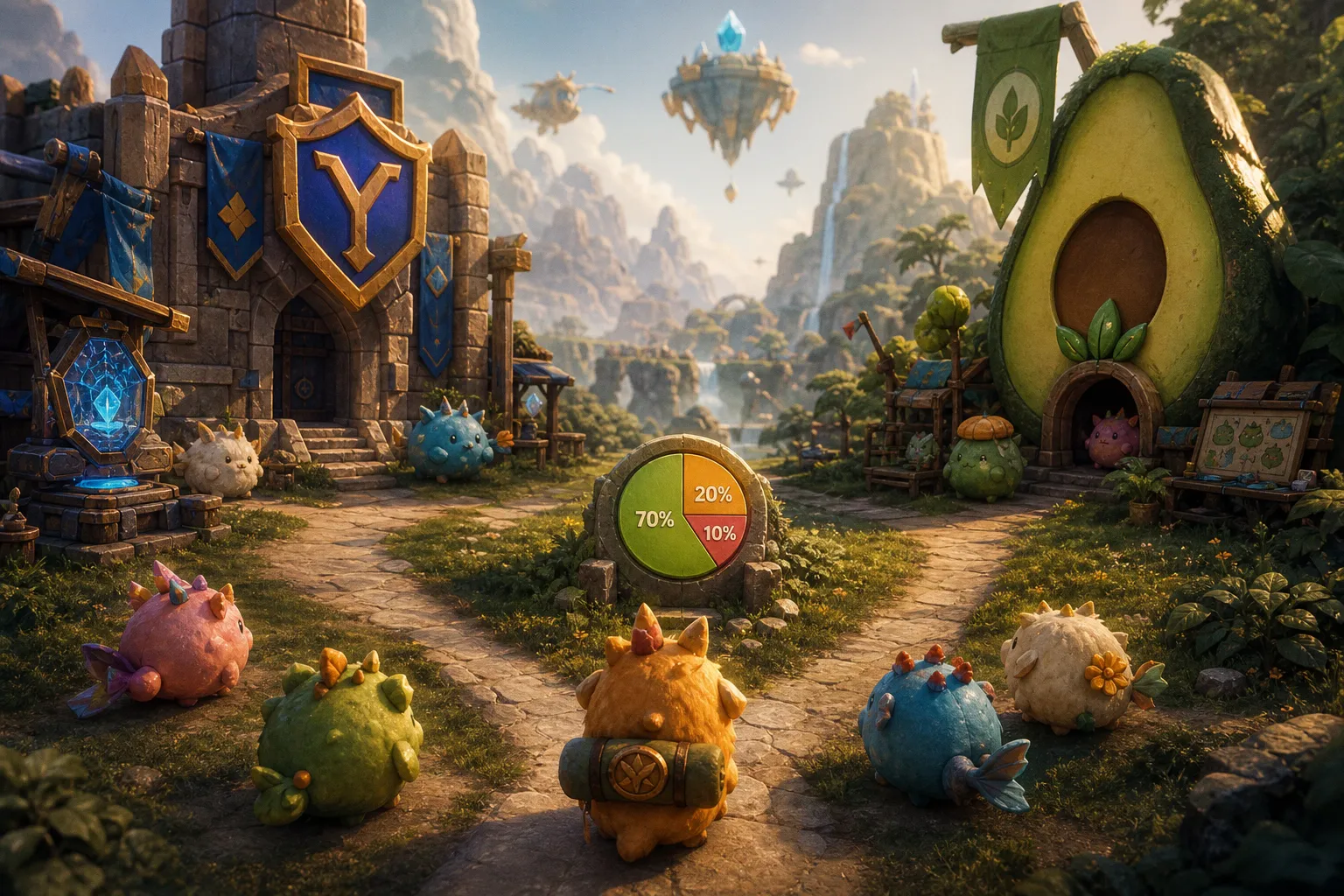
The choice between these two organizations has evolved far beyond who offers the most attractive payout split. Today, both have rebranded, restructured, and reassessed how they align their financial incentives with the players who drive their ecosystems. To make an informed decision on how to check choose ygg or avocado guild for axie scholarship nft programs, you must look past the legacy marketing and dissect how these organizations manage their treasuries, govern their communities, and support their members in a rapidly maturing GameFi landscape.
The Evolution from Scholarship Managers to Web3 Infrastructure
The old playbook of simple asset lending is dead. In the early days of the play-to-earn boom, guilds functioned primarily as digital landlords. They purchased expensive in-game assets—specifically Axie Infinity teams—and loaned them to players (scholars) who lacked the upfront capital to start. In exchange, the guild took a cut of the daily earnings. The model was brutally simple: buy, lend, skim, repeat.
Today, both Yield Guild Games and Avocado DAO have transitioned away from the term "scholarship" entirely. They champion "player programs," "gaming partnerships," and "ecosystem onboarding." This shift is not merely cosmetic. It is a direct response to the changing tokenomics of Axie Infinity—where SLP inflation eroded the raw earning potential that made the original model viable—and the broader migration of the Web3 gaming market toward free-to-play and hybrid structures that make the old lending framework economically irrelevant.
Yield Guild Games pioneered the "guild-of-guilds" model. Instead of managing every player from a centralized hub, YGG decentralized its operations into regional subDAOs such as YGG Japan, YGG PILIPINAS, and YGG Southeast Asia. Each subDAO operates with semi-autonomous leadership, allowing local managers to customize programs to the specific economic needs, internet infrastructure, and labor markets of their regions. A scholar in Manila faces a completely different set of cost-of-living calculations and gaming opportunities than a scholar in São Paulo, and YGG's structure acknowledges that reality rather than flattening it into a single global contract.
Avocado DAO took a fundamentally different path. Rather than fragmenting into regional arms, Avocado focused on building centralized infrastructure—specifically its Avocado Portal—that simplifies how players interact with multiple Web3 games. The thesis here is that onboarding friction is the biggest bottleneck in Web3 gaming adoption. If a new player has to manage multiple wallets, bridge tokens across chains, and figure out separate game clients for every title, most will quit before they earn their first token. Avocado's answer is to compress that complexity into a single interface, positioning itself not just as a guild but as a gateway.
For someone weighing how to check choose ygg or avocado guild for axie scholarship paths, this structural difference translates directly into your daily experience. YGG offers a localized, community-driven experience through its subDAOs—you are embedded in a regional cohort with shared language, time zones, and cultural context. Avocado provides a unified, tech-forward ecosystem that aims to onboard you into a wider variety of digital applications regardless of geography.
Governance Structures and Token Utility in YGG and Avocado DAO
Your voice in a guild is only as strong as its governance design. When you join a DAO, you are not simply an employee following directives from management. You are a stakeholder with a theoretical claim on the direction of the organization. Both YGG and Avocado DAO utilize native utility tokens ($YGG and $AVG) to distribute voting power and direct their treasuries. However, the way each organization handles the tension between large token holders and grassroots players reveals sharply different philosophies.
In YGG, holding $YGG allows you to vote on index-style proposals, asset allocations across subDAOs, and partnerships with new games. The structural challenge—one common to nearly every large DAO—is voter apathy compounded by concentration risk. Because institutional investors and early backers often hold significant token blocks, an individual grassroots player's vote can feel negligible. YGG has responded to this problem by introducing soulbound tokens and reputation systems: non-transferable badges that track your in-game achievements, tournament participation, and community contributions. These reputation markers don't replace token-based voting, but they create a parallel layer of influence where active players can demonstrate credibility and gain weight in community discussions without needing to accumulate large token holdings.
Avocado DAO uses its $AVG token to power a different mechanism—one anchored in its community portal. The emphasis here is on rewarding social alignment and platform engagement. Players earn governance weight not primarily through in-game performance but through participating in quests, contributing to community forums, referring new members, and voting on portal-specific initiatives. This creates a governance culture that rewards evangelism and community building as much as (or more than) raw gaming skill.
"Decentralization without accessible governance is just a brand exercise. The real test is whether a player grinding in a local internet cafe can meaningfully influence the treasury managers directing the guild's capital."
If you value a reputation-based system where your in-game achievements translate directly into social standing and governance influence, YGG's layered model is compelling. If you prefer a more unified, portal-driven ecosystem where social engagement and platform quests are the primary currency of community power, Avocado's setup aligns better with those priorities.
Deconstructing Revenue-Sharing: Beyond the Legacy 70/20/10 Model
The standardized split is a relic. During the peak of the Axie Infinity phenomenon in 2021, the revenue-sharing model was brutally straightforward: 70% of the earned Smooth Love Potion (SLP) went to the scholar, 20% went to the community manager who trained and monitored them, and 10% went directly back to the guild treasury. It was simple, universally understood, and—critically—built on the assumption that SLP would maintain enough value to make the split meaningful for all three parties.
That assumption collapsed. SLP inflation, declining player counts, and the broader crypto market downturn eroded the economics that made 70/20/10 sustainable. Both guilds have since moved toward variable, performance-driven compensation structures managed through automated smart contracts. The specific split you receive now depends on the game you are playing, the rarity and utility of the NFT assets being leased to you, your performance tier, and the particular community agreement you signed when onboarding.
| Parameter | Yield Guild Games (YGG) | Avocado DAO (AVG) |
|---|---|---|
| Primary Focus | Regional subDAOs and specialized gaming partnerships | Infrastructure, incubation, and ecosystem portals |
| Native Token | $YGG (governance & subDAO indexing) | $AVG (governance & portal rewards) |
| Asset Management | Decentralized vaults across multiple chains | Centralized treasury with incubation focus |
| Onboarding Style | Grassroots, localized community hubs | Tech-driven onboarding via the Avocado Portal |
| Compensation Model | Performance-based, negotiated per subDAO | Tiered rewards tied to portal engagement |
| Multi-Game Flexibility | High—reputation transfers across YGG portfolio | Medium—portal access to curated titles |
Because splits are no longer static, players researching how to check choose ygg or avocado guild for axie scholarship opportunities must actively dig into current community agreements rather than relying on historical benchmarks. Neither guild currently runs a one-size-fits-all Axie program with a published universal rate card. Instead, you need to join their respective Discord servers, review their active player programs, and examine the specific terms encoded in their smart contract agreements before committing your time.
It is also worth recalibrating how you evaluate the split itself. A guild that takes a slightly larger percentage but provides top-tier coaching, asset upgrades, and pathways to competitive representation may yield higher net returns than a guild offering a generous headline number with zero support infrastructure. The percentage on paper is only half the equation; the value of what flows back to you in training, tooling, and opportunity is the other half.
Portfolio Diversification and Multi-Game Ecosystem Strategies
A guild's treasury composition is its immune system. If a DAO's holdings are heavily concentrated in a single game's assets, any downturn in that game's economy becomes an existential threat. Both YGG and Avocado learned this lesson painfully during the Axie market corrections of late 2021 and 2022, when treasury valuations tied to Axie NFTs dropped sharply and guild revenues contracted almost overnight.
YGG has since evolved into something resembling an investment index for Web3 gaming. Its treasury holds positions across dozens of titles, spanning MMORPGs, card battle games, strategy titles, and emerging genres. This diversification serves a dual purpose: it protects the guild's overall financial health from any single game's downturn, and it creates optionality for players. If you grow tired of one title or its economy enters a quiet season, YGG's structure makes it relatively straightforward to transition your skills, reputation, and earning potential to another game within their portfolio. The subDAO model reinforces this—you might start as an Axie specialist in YGG PILIPINAS and gradually expand into other titles managed by the same regional node.
Avocado DAO has pursued diversification through a different lens. Rather than accumulating NFT inventories across many games, Avocado has invested in the underlying infrastructure of Web3 gaming itself. They support developers during early-stage game creation, securing early access, exclusive asset allocations, and favorable onboarding terms for Avocado community members. This incubator strategy means Avocado members often get first access to promising new titles before they hit mainstream awareness—front-running the player influx that typically follows a game's breakout moment.
For a player, this distinction matters. YGG offers breadth: a portfolio of active games you can rotate through based on market conditions and personal preference. Avocado offers early access: a curated pipeline of emerging titles where you can establish yourself before competition intensifies. Neither approach is categorically superior—it depends on whether you prefer stability through diversification or opportunity through early positioning.
Navigating Modern Player Programs in a Free-to-Play Landscape
The prerequisite cost barrier that defined the scholarship era has largely dissolved. Axie Infinity itself moved to a free-to-play model, and most new Web3 games launch with low or zero upfront entry requirements. This shift fundamentally changes what a guild offers. You are no longer looking for someone to lend you an Axie team because you cannot afford one. You are looking for a digital community that accelerates your growth, protects your interests, and connects you to opportunities you would not find alone.
Before committing to either organization, take these steps to evaluate their current state:
1. Audit Discord activity. Join both the YGG and Avocado DAO Discord servers. Do not rely on outdated blog posts or YouTube reviews from 2021. Look at announcement channels, active recruitment threads, and the responsiveness of community managers. If the Axie-specific channels are dormant while newer game channels are thriving, that tells you where the guild's real priorities lie.
2. Test onboarding friction. Sign up for Avocado's portal and investigate YGG's regional subDAO application process. The speed and clarity of onboarding reveals how much the guild has invested in member experience. A guild that makes you wait weeks for a response or sends you through a confusing sign-up flow is unlikely to provide strong ongoing support.
3. Review treasury transparency. Both DAOs publish treasury reports or on-chain data you can inspect. Check these to confirm the organization has the financial runway to sustain player programs. A guild with a depleted treasury may promise generous splits it cannot actually fund.
4. Evaluate support infrastructure. Look for active coaching sessions, strategy guides updated for current game metas, and regular community events. A guild that drops assets into your wallet and leaves you to figure out the optimal play on your own is offering you a transaction, not a partnership.
5. Factor in long-term sustainability. Web3 gaming careers are marathons, not sprints. Consider whether the guild structures its programs around burnout prevention, reasonable session expectations, and paths to growth beyond raw playtime. A guild that treats you as a disposable throughput node will churn through your energy and move on; one that invests in your development as a strategist, community leader, or content creator is building something worth committing your time to.
"The best guild is not the one with the highest headline split. It is the one that makes you a better player, a sharper Web3 citizen, and a stakeholder whose voice actually shapes the community's direction."
Ultimately, this decision comes down to where you feel your time and energy are most respected. YGG's regional subDAO model rewards players who want to embed deeply in a specialized, localized community and build reputation as a domain specialist across a diversified game portfolio. Avocado's portal-centric ecosystem rewards players who value streamlined onboarding, early access to emerging titles, and a community culture that prizes social engagement alongside gaming performance.
Neither path is wrong. But they lead to different kinds of careers in Web3 gaming. The question worth sitting with is not just "which guild pays more"—it is which guild structure gives you the tools, the voice, and the platform to build something durable in a virtual economy that is still being written.