DAO governance: why community voting defines GameFi success
- Less than 10% of eligible holders often vote in routine GameFi governance proposals.
- That is the operating metric behind most claims of community ownership.
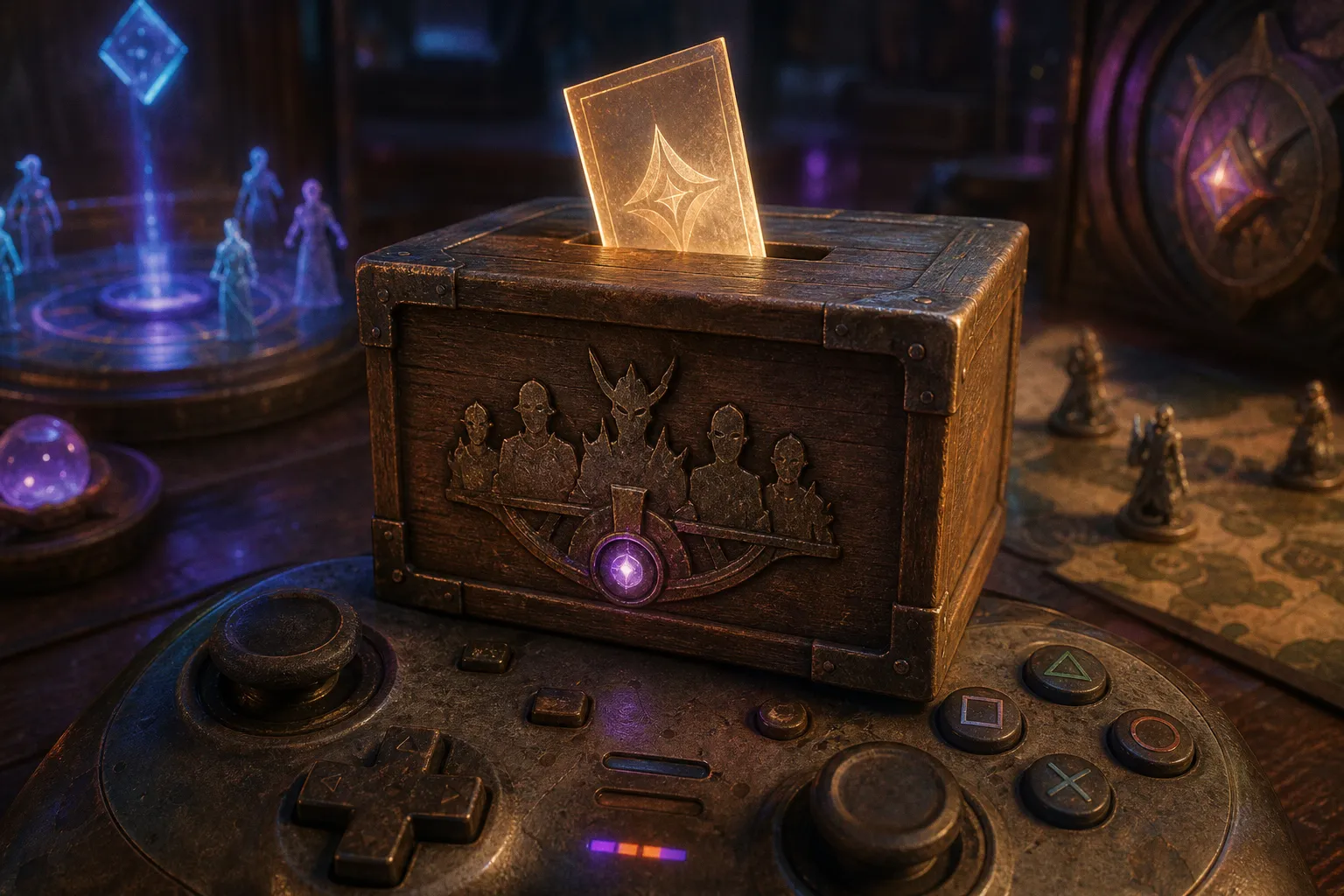
DAO governance changes who can authorize treasury spending, alter emissions, approve game parameters, or deploy liquidity. It does not automatically distribute real control. In many gaming ecosystems, the governance token remains a financial asset first and a voting instrument second. The gap matters because game economies are unusually sensitive to bad capital allocation. A weak vote can turn a treasury into a liquidity sink. A delayed vote can leave an exploit unpatched. A token-weighted vote can convert decentralized voting into a clean interface for whale control.
The market should treat governance as infrastructure. It determines where value flows after a token launch, when scholarships are expanded or cut, and whether a gaming treasury is used to compound ecosystem assets or subsidize short-term activity.
The decentralization shift is about cash flow, not slogans
GameFi DAO governance emerged from a direct conflict of incentives. Developers control code, game balance, token emissions, and capital. Players and asset holders absorb the consequences: inflation, falling NFT floors, depleted reward pools, and liquidity fragmentation.
Community-led decision making is intended to move some of that authority into a formal voting process. Holders can vote on proposals concerning:
- Treasury deployment into game assets, ecosystem investments, grants, or market making.
- Reward emission curves and the split between player incentives, staking yields, and operational reserves.
- Scholarship program budgets, manager compensation, and the acquisition of rentable NFTs.
- Changes to game mechanics that directly affect asset utility and token demand.
- Governance structure itself: quorum thresholds, voting windows, council mandates, and delegation rights.
The distinction is material. A DAO that votes only on cosmetic grants is not governing the economic system. A DAO that can allocate treasury capital, revise incentive schedules, and approve protocol-level changes is closer to an actual control layer.
Illuvium provides a structured example. Its Illuvinati Council consists of five elected representatives who vote on Illuvium Configuration Proposals and Illuvium Improvement Proposals. This is not pure direct democracy. It is representative governance with a constrained decision-making body. That trade-off reduces operational latency. It also concentrates authority in five seats.
Yield Guild Games uses a different architecture. The main DAO sits above sub-DAOs such as YGG SEA and YGG Japan. This structure fits the economics of guild operations. Scholarship programs are local. Game demand is local. The useful asset mix can vary across regions and titles. A central treasury can set capital policy while sub-DAOs manage narrower operational exposure.
Neither structure eliminates centralization risk. Both make it visible. That is already an improvement over a developer-controlled treasury with vague community consultation.
In GameFi, governance is not a feature layer. It is the capital-allocation engine behind the token.
One token, one vote remains the default — and the weak point
The standard model is simple: one governance token equals one vote. It is easy to implement, easy to audit, and compatible with liquid token markets. It also assumes that economic exposure should map directly to political power.
That assumption fails when token ownership is concentrated.
A large holder can accumulate voting power through open-market purchases, OTC deals, early allocations, or delegated balances. The same holder can then influence the treasury that supports the token’s market structure. This is not necessarily malicious. It is simply a conflict that token-weighted governance does little to price in.
The practical issue is not whether a whale has a vote. A whale with meaningful downside exposure may make disciplined decisions. The issue is whether the voting system distinguishes between long-term capital, short-term arbitrage capital, insiders, and passive holders who never participate.
| Parameter | Token-weighted voting | Quadratic voting |
|---|---|---|
| Basic rule | One token equals one vote | Additional votes become progressively more expensive |
| Large-holder influence | Directly proportional to token balance | Reduced at the margin |
| Small-holder influence | Usually diluted | Relatively stronger |
| Sybil resistance | Native if tokens are scarce | Requires careful identity or cost design |
| Main failure mode | Treasury capture by concentrated holders | Wallet splitting or identity manipulation |
| Best fit | Clear capital ownership and liquid governance tokens | Decisions where breadth of preference matters |
Quadratic voting is designed to reduce the linear advantage of large balances. The cost of accumulating additional votes rises quadratically rather than one token per vote. In theory, this gives smaller participants more relevance in collective decisions.
In practice, the model has a structural dependency: identity. If one actor can split holdings across many wallets, quadratic voting loses much of its protection. GameFi has a particular problem here. Wallet creation is cheap. Scholarship systems often involve many accounts. Players, guild managers, and asset owners may be economically linked while appearing as independent voters.
That does not make quadratic voting unusable. It means the mechanism should not be presented as a cure for governance capture. It is a trade-off between concentration resistance and verification complexity.
For treasury decisions, a hybrid structure is often more defensible:
1. Token-weighted voting for broad capital mandates. Holders approve a treasury range, strategic allocation category, or annual budget envelope.
2. Specialized councils for execution. Elected or delegated groups deploy capital inside the approved mandate, subject to transparent reporting.
3. Higher thresholds for irreversible actions. A routine grant should not use the same approval bar as a token migration, major emission change, or treasury conversion.
4. Time delays on critical proposals. A delay creates room for market scrutiny, delegate response, and exit before a high-impact decision is executed.
A 66% supermajority is common for critical protocol changes. It is not a guarantee of legitimacy. If turnout is 8%, then 66% approval may represent a small fraction of all eligible voting power. Quorum design matters as much as the approval threshold.
Snapshot lowers voting costs. It does not create participation.
Most GameFi DAOs use Snapshot for off-chain, gasless voting. Token holders sign messages rather than submit on-chain transactions and pay Ethereum fees. This removes a real barrier. During periods of high network fees, on-chain voting can make participation irrational for smaller holders.
But gasless voting changes the cost of casting a vote, not the cost of understanding a proposal.
A treasury allocation proposal can require analysis of token liquidity, NFT inventory, vesting schedules, counterparty risk, runway, and game-specific demand. Most holders will not do that work. The result is predictable: voter apathy.
Routine participation below 10% is not a minor governance inconvenience. It changes the meaning of an approved proposal. Low turnout increases the relative influence of:
- Core contributors and early token holders with large balances.
- Professional delegates who can process governance flow at scale.
- Treasury-linked entities with direct incentives to protect existing positions.
- Funds that acquired tokens for governance arbitrage rather than game participation.
- Highly organized guild blocs that can coordinate voting across delegated wallets.
This is why raw voter count is a weak metric. A proposal with 5,000 votes may be less decentralized than one with 200 votes if the former is dominated by a handful of wallets.
The better data set includes voting power concentration, turnout as a share of circulating supply, delegate concentration, proposal frequency, and the ownership profile of wallets that decide close votes. Governance dashboards often display the first number available. The market should demand the numbers that explain control.
Proposal duration is a liquidity decision
Typical GameFi governance votes run for seven to 14 days. That window is not administrative detail. It changes the market mechanics around a proposal.
A short voting period favors actors already monitoring the DAO and holding liquid inventory. A long period gives more time for discussion and delegation, but it may delay necessary operational changes. During a token drawdown or a security incident, governance latency can become expensive.
The solution is not to shorten every vote. It is to classify decisions by reversibility.
A small grant, a community event budget, or a limited game-asset purchase can tolerate a standard vote. A treasury deployment into a volatile asset, a major change to reward emissions, or an upgrade affecting withdrawal logic requires longer scrutiny and stronger quorum. Emergency powers may still be necessary, but they should be narrowly defined and auditable.
Any DAO with admin keys or emergency controls should state that plainly. Full decentralization should not be assumed merely because a governance token exists.
Gasless voting removes transaction friction. It does not remove information asymmetry, holder concentration, or delegated power.
Guilds turn governance into an operating system
Gaming guilds add another layer to DAO governance because they do not merely hold governance tokens. They manage productive assets.
In a scholarship model, the DAO or guild treasury acquires game assets, allocates them to operators or scholars, receives a share of generated rewards, and decides whether to reinvest, sell, or diversify. The model can create scale. It can also magnify bad assumptions.
If reward tokens inflate faster than new demand enters the game, scholarship revenue falls. If the guild continues acquiring assets to preserve activity metrics, the treasury accumulates illiquid inventory. If governance rewards managers based on gross output rather than net returns, the system can subsidize loss-making operations for too long.
That is why gamefi treasury management needs reporting that resembles an investment operation, not a community update.
A functional guild DAO should expose, at minimum:
- Liquid treasury ratio: how much of the treasury can be deployed or used to cover operating costs without forcing NFT sales.
- Asset concentration: exposure to a single game, token, collection, or reward stream.
- Scholarship unit economics: gross rewards, manager share, player share, asset depreciation, and net return after all incentives.
- Token emission exposure: whether yields are generated by external demand or by newly issued tokens entering the market.
- NFT floor resistance: whether acquired assets retain utility and bid support when incentives decline.
- Treasury-to-token mismatch: whether the DAO token trades at a valuation disconnected from verifiable net asset value.
Yield Guild Games’ use of a main DAO and multiple sub-DAOs reflects this operational reality. A broad organization can set treasury policy, but regional units can manage specific player bases, games, and asset pools. The model is more flexible than forcing every scholarship decision through a single global vote.
It also introduces another risk: opacity between layers. A main DAO may hold the governance token and central treasury while sub-DAOs hold local relationships, operating data, and assets. If reporting is fragmented, token holders cannot assess where revenue is generated or where losses are accumulating.
The same issue applies to Web3 esports structures. A team DAO can finance rosters, tournament participation, content, and game assets. The governance question is not whether the community votes on a logo. It is whether the DAO can measure the return on those expenditures against token dilution and treasury drawdown.
Treasury control is where governance stops being theoretical
Merit Circle’s shift toward the Beam network and a Treasury-as-a-Service focus is a useful signal. The organization managed a treasury that peaked above $100 million in assets. At that scale, governance is not a social coordination exercise. It is asset management with a token-holder electorate.
The central question becomes simple: what should a gaming treasury own?
A treasury can hold stablecoins, native governance tokens, NFTs, equity-like token positions, validator or infrastructure exposure, and ecosystem investments. Each category has a different liquidity profile and correlation structure.
Holding too much of the DAO’s own token creates reflexivity. When the token rallies, reported treasury value rises. When the token sells off, both treasury value and governance confidence contract at the same time. That is a balance-sheet feedback loop, not diversification.
Holding too many game NFTs creates another problem. NFT valuations can look stable while liquidity has already disappeared. A floor price is not an exit price for a treasury-sized position. The spread between visible floor and realizable liquidation value can widen sharply during a drawdown.
Treasury votes should therefore be assessed by their impact on three variables:
1. Runway: how long the DAO can operate if reward revenue declines and token liquidity deteriorates.
2. Liquidity: whether the treasury can meet obligations without selling concentrated positions into thin markets.
3. Reflexivity: how much treasury value depends on the same token incentives the DAO is attempting to govern.
A vote to purchase ecosystem assets may be defensible. A vote to buy illiquid NFTs from insiders at an optimistic floor is not capital deployment. It is balance-sheet transfer.
The difference is disclosed terms, independent valuation discipline, and conflict management. Governance tokens do not solve related-party transactions by themselves.
Developers still need speed. Token holders need boundaries.
The most persistent DAO governance problem in games is the clash between decentralization and iteration speed.
Games require patches, balance adjustments, anti-cheat responses, live operations, and content decisions. Subjecting every parameter to a seven-day vote can make a game unplayable. Leaving every parameter under developer control makes governance cosmetic.
The workable boundary is not “community decides everything.” It is a clear split between operational discretion and economic authority.
Developers should retain room to patch gameplay, fix exploits, and adjust live systems within disclosed constraints. Token holders should control changes that materially alter asset economics: emission schedules, treasury allocations, major monetization changes, protocol upgrades, or the sale and dilution of governance rights.
Axie Infinity’s progressive decentralization roadmap, launched in 2022, illustrates the broader direction of travel: governance is usually transferred in stages, not switched on at a single moment. That is the realistic model. The market should be skeptical of projects that market themselves as fully decentralized while core contracts, treasury execution, or game servers remain under unilateral control.
Decentralization is a spectrum. The relevant question is where control actually sits today:
- Who can upgrade contracts?
- Who can move treasury assets?
- Who sets reward emissions?
- Who can change the game economy without a vote?
- Who controls the voting interface, delegation rules, and proposal pipeline?
If the answer to most of those questions is “the founding team,” the DAO token has limited governance value regardless of its branding.
The risk assessment
DAO governance can improve GameFi economics when it creates visible constraints on treasury use, emissions, and protocol changes. It can also formalize the influence of the largest holders while giving passive participants the appearance of control.
The key risk is not that voters make imperfect decisions. Every capital allocator does. The key risk is that governance design hides concentrated power, delays necessary action, or rewards activity that consumes treasury resources without producing durable demand.
For token holders, the relevant signal is not the number of proposals passed. It is whether votes govern material cash flows, whether participation is broad enough to resist capture, and whether the treasury can survive a sustained drawdown without liquidating its own thesis.
A GameFi DAO succeeds when governance reduces extraction. If voting only redistributes emissions, protects insiders, or funds illiquid asset accumulation, it is not decentralized management. It is a slower version of centralized risk.