Digital collectibles in gaming: the 5-minute essentials
- NFT trading volume fell 45% quarter over quarter to $867 million in Q2 2025.
- The number of sales moved in the opposite direction: up 78%, to 14.9 million.
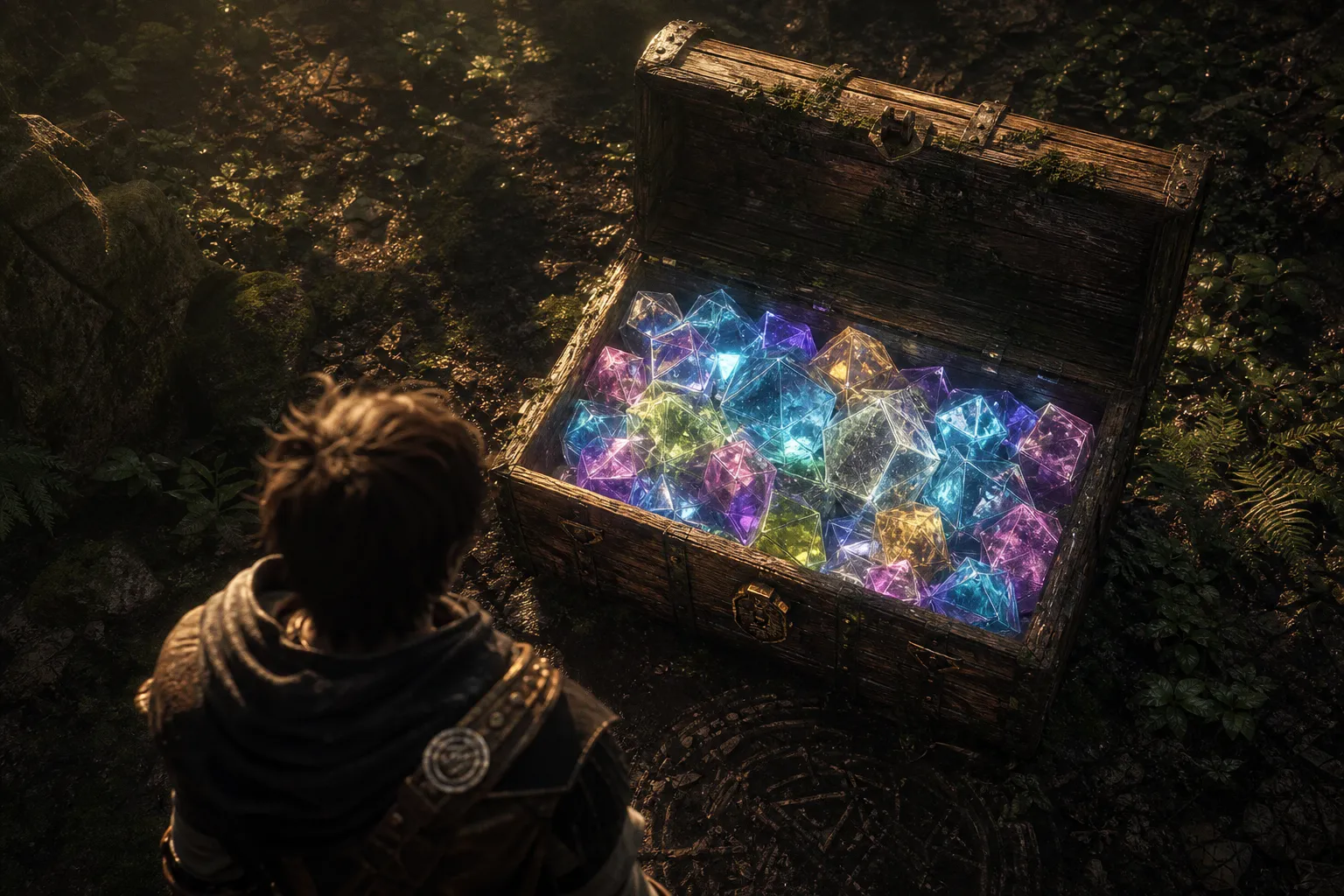
That divergence is the market in one chart. Digital collectibles did not disappear. Their average ticket size compressed. Capital rotated away from scarce, expensive metaverse real estate and toward lower-priced in-game digital assets with a clearer use case, shorter holding period, or both.
The distinction matters. Gaming NFTs are no longer one asset class. A virtual land parcel, a collectible card, a character NFT with an inventory, and a cosmetic wearable may all settle on the same marketplace. Their liquidity, cash-flow logic, and downside profile are not comparable.
The great repricing: virtual land lost its scarcity premium
Metaverse land was priced as if location alone would produce demand. That assumption failed under thin user activity and weak secondary-market liquidity.
The drawdown is not marginal.
A Snoopverse estate in The Sandbox sold for $450,000 in December 2021. By March 2026, its floor-equivalent value was roughly $1,025. That is a 99.8% decline. A Decentraland Fashion District estate bought for $2.4 million in November 2021 had a floor-equivalent value near $8,929 by March 2026, down 99.6%.
These are extreme examples. They are also structurally useful examples.
Virtual land is not automatically productive property. It has no inherent rental yield, no legally enforceable local monopoly, and no guarantee that players will congregate around a given coordinate. Its value depends on a chain of conditions:
- The game or world needs sustained active users, not wallet counts or campaign traffic.
- Landowners need a credible way to monetize placement, experiences, advertising, or access.
- The platform must keep building without expanding land supply or diluting attention.
- Buyers need enough exit liquidity to treat a quoted floor as executable value.
Break one link and the valuation model weakens. Break several and the floor becomes a stale reference point rather than a market price.
The Sandbox’s August 2025 workforce reduction, which exceeded 125 employees and represented more than half of its staff, made the operational risk visible. Platform execution is not a background variable for metaverse collectibles. It is the asset thesis.
A land NFT is not real estate. It is a long-duration claim on a platform’s ability to retain attention.
That does not make virtual land worthless. It makes it venture-like. The buyer is underwriting product delivery, player acquisition, creator economics, token incentives, and marketplace depth at once. The 2021 market largely priced the tokenized deed and ignored the operating business underneath it.
Why volume is falling while sales are rising
The Q2 2025 data shows a market moving down the price curve. Total NFT trading volume dropped to $867 million, but transaction count reached 14.9 million. More units changed hands. Less capital was committed per unit.
That is consistent with the current structure of digital collectibles in gaming.
| Parameter | High-ticket virtual land | Utility-driven gaming collectible |
|---|---|---|
| Typical buyer thesis | Future platform scarcity | Immediate in-game use or collection demand |
| Liquidity profile | Thin, fragmented, episodic | Often higher turnover at lower values |
| Price discovery | Floor-led, vulnerable to stale listings | Sales-led, easier to benchmark |
| Main risk | Narrative collapse and no buyer depth | Utility decay, emissions, balance changes |
| Holding period | Usually long and illiquid | Often event-, season-, or meta-driven |
| Supply pressure | New districts, worlds, parcels | New mints, rewards, crafting, battle passes |
The lower-value shift is not automatically healthy. High transaction count can be manufactured by reward loops, low-cost mints, wash activity, or marketplace fee incentives. A wallet making repeated purchases of $3 assets creates sales count. It does not create durable demand.
Still, cheaper assets solve a basic market constraint. A player can test a game economy with a low-cost skin, card, weapon component, or companion. A $50,000 land position requires a different buyer: one willing to absorb a near-total drawdown if the platform misses its user-growth targets.
The market is therefore becoming more granular. Instead of one illiquid NFT representing a broad bet on “the metaverse,” capital can target specific gameplay loops:
1. Collectibles that unlock access. Tournament entries, gated modes, seasonal content, or crafting rights can produce demand independent of resale speculation. The access must remain meaningful after the initial launch window.
2. Assets with constrained utility. A character, card, or equipment item can matter if it has a defined role in a competitive or economic loop. Unlimited utility claims are usually marketing language. Utility has to survive balance patches.
3. Cosmetics with social visibility. Wearables and avatar items depend on audience density. Their value rises when other users can see them repeatedly. A cosmetic in an empty world has weak network effects.
4. Crafting inputs and consumables. These can create turnover, but they also introduce supply risk. If emissions outpace sinks, holders become inventory providers for newer entrants.
5. Complete collectible sets. Set mechanics can create natural demand for low-priced assets, particularly in card games. The risk is that each new release resets the prior set’s relevance.
The useful metric is not simply floor price. It is the relationship between active listings, completed sales, median sale price, holder concentration, and the rate at which new supply enters circulation. Floors are easy to display. Sell-through is harder to fake.
The asset economy is replacing the land narrative
The broader digital collectibles market was valued at $31.2 billion in 2025 and is projected to reach $198.6 billion by 2034. The projected 22.9% annual growth rate is large, but it should not be confused with a forecast for every NFT category.
Aggregate market growth does not repair failed liquidity pools. It reallocates capital.
For in-game digital assets, the viable model is narrower than the headline numbers suggest. A collectible needs a reason to exist after the mint. This usually means one of three things: functional utility, persistent identity, or constrained supply matched to actual activity.
The weakest model is the collectible with all three negatives:
- no in-game role;
- no social distribution;
- no credible supply discipline.
That asset depends entirely on a later buyer assigning a higher value. It is not an economy. It is inventory without consumption.
GameFi teams often obscure this problem through token rewards. An NFT receives yield because the protocol emits tokens; the token remains valuable because users are encouraged to buy NFTs. The circularity holds only while new capital offsets emissions and unlocks. Once token sell pressure exceeds fresh demand, the NFT floor and the reward token can enter a joint drawdown.
A more stable system has identifiable sinks. Repair costs, crafting burns, tournament entry fees, upgrade failures, rental collateral, and cosmetic customization can remove value or tokens from circulation. Not every sink is good design. Punitive sinks can damage retention. But an economy without sinks tends to turn every reward into future sell pressure.
Utility is not a feature list. It is a measurable source of recurring demand that offsets supply.
This is where virtual items value becomes a game-design question before it becomes a market question. A rare sword may be scarce on-chain. If a balance update makes it obsolete, scarcity simply concentrates an unwanted asset among fewer holders.
ERC-6551 changes what a character NFT can hold
The next technical shift is less visible than a land sale, but more relevant to asset design.
ERC-6551, commonly described as Token Bound Accounts, allows an ERC-721 NFT to control a smart-contract wallet. In practical terms, a character NFT can own other assets. Equipment, consumables, badges, quest items, and tokens can be attached to the character rather than sitting separately in the player’s wallet.
That changes the unit of ownership.
Under a basic NFT structure, a player might hold a character in one contract, armor in another, a badge in a third, and currency in a wallet. Transferring the character does not automatically transfer the associated inventory. The seller can strip the valuable items first. The buyer receives the shell.
With a token-bound account, the character can become the container. The buyer can acquire a bundled on-chain state, subject to the game’s contract rules.
The potential advantages are concrete:
- Portfolio integrity. A character’s equipment and progression can move with the character, reducing fragmented settlement.
- Cleaner marketplace pricing. A buyer can value an assembled build instead of estimating each component separately.
- Composable game logic. Contracts can verify assets held by the character account rather than relying only on wallet-level ownership.
- Account history. Reputation, achievements, and transaction activity can be associated with the NFT identity.
The risks are equally concrete.
A token-bound account can make an NFT harder to value because its contents change. A character floor may no longer represent a comparable asset if some units hold rare gear and others do not. Marketplaces need better metadata, indexing, and bundle visibility. Otherwise, buyers face adverse selection: the visible NFT price understates the hidden differences in inventory.
There is also contract risk. The more assets and permissions an NFT account controls, the more important its implementation becomes. Gaming NFTs with modular wallets are not simply images with provenance. They are transaction-bearing smart-contract positions.
ERC-5606 and the narrow path to interoperability
Cross-game NFTs remain a popular claim with limited evidence of mainstream execution. The technical standards are improving. Product adoption is still the constraint.
ERC-5606 defines a minimal interface for Multiverse NFTs. It is designed to let an asset, such as a wearable, index delegate NFTs across multiple platforms and support bundling or unbundling. The standard provides a way to express relationships between a primary collectible and its representations elsewhere.
This matters because an asset can have several forms without becoming several unrelated assets. A helmet may exist as a canonical NFT, then be represented or delegated in different game environments. That is cleaner than minting disconnected “official” copies across chains and ecosystems.
But interoperability has layers. They should not be conflated.
| Layer | What it enables | What it does not guarantee |
|---|---|---|
| Ownership portability | A wallet can prove it holds an NFT | The receiving game will recognize it |
| Asset representation | An item can have a mapped version elsewhere | Identical visual quality or functionality |
| Gameplay compatibility | A game can assign stats or use cases | Balance parity across different games |
| Economic portability | An item can retain tradeable status | A stable floor price or continuous liquidity |
The difficult layer is gameplay compatibility. One game’s rare weapon can be another game’s cosmetic skin, badge, or unusable object. Developers protect balance because balance determines retention and monetization. No standards body can force a studio to import an external item with external stats into a competitive environment.
The practical near-term use case is not a sword moving unchanged between unrelated games. It is identity and cosmetic continuity: avatars, badges, wearables, profile items, collection status, and controlled representations across partnered environments.
That is still useful. It just does not justify pricing every interoperable NFT as an option on an infinite metaverse.
Collectible card games have a clearer demand loop
Digital collectible card games are a more legible segment than virtual land. The category is valued at $0.94 billion in 2026 and projected to reach $2.64 billion by 2035, a 12.18% compound annual growth rate.
The reason is structural. Cards are not just display objects. They can be game pieces, deck-building inputs, tournament requirements, and collection targets. Demand has a recurring trigger: new sets, ranked formats, events, and meta shifts.
That does not eliminate risk. It relocates it.
Card economies tend to fail through overprinting, power creep, rental distortions, or a reward schedule that turns every active player into a net seller. A card NFT can also be technically scarce but economically common if competitive players treat it as mandatory inventory.
The stronger models separate three functions:
- Play inventory needs broad availability. A game cannot retain players if viable decks are locked behind a small number of expensive NFTs.
- Collectible scarcity can support premium variants, serialized editions, cosmetics, and historical sets.
- Economic sinks need to absorb surplus assets or currency without making progression punitive.
This separation is missing in many early GameFi designs. They use the same NFT both as an entry ticket, an income-producing asset, and a speculative collectible. That creates a single point of failure. If earnings compress, player demand falls; if player demand falls, the collectible floor weakens; if the floor weakens, the earning proposition deteriorates further.
The card-game format can avoid some of this because players have reasons to hold cards beyond emissions. But only if the game remains playable, strategically updated, and accessible without constant capital deployment.
The strict risk assessment
Digital collectibles are moving from broad narrative exposure toward narrower utility exposure. The evidence is visible in market behavior: lower dollar volume, more sales, and a collapse in the premium once assigned to metaverse land.
The market’s next winners will not be determined by the word “NFT” in a roadmap. They will be determined by whether an asset has liquidity, a supply ceiling that holds under live operations, and demand that does not rely on token emissions.
ERC-6551 and ERC-5606 improve the technical rails. They can make ownership more programmable, bundled, and portable. They do not create players, marketplace depth, or economic sinks.
The hard filter remains unchanged. Treat gaming NFTs as high-volatility digital inventory unless the underlying game can demonstrate recurring usage, controlled issuance, and real secondary-market turnover. A floor price without bids is not support. It is an untested assumption.